As mentioned in the May post, this year I am tracking all the native plants and the months they bloom in. The goal is to support pollinators by having an abundance of blooms of different shapes and colors throughout the growing season. Once tracked, I can evaluate whether there are any missing times or types of blooms. And then I can plant more next year!
Trees and Shrubs
June continued to see more shrubs and trees supplying a good share of the blooms for pollinators.
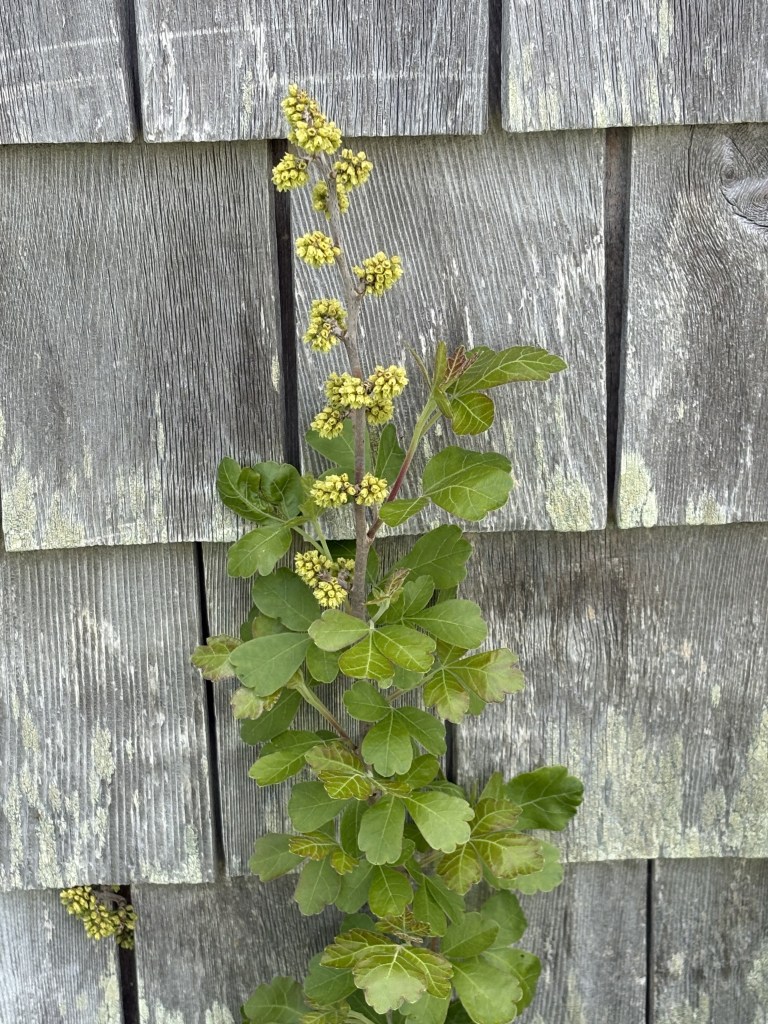
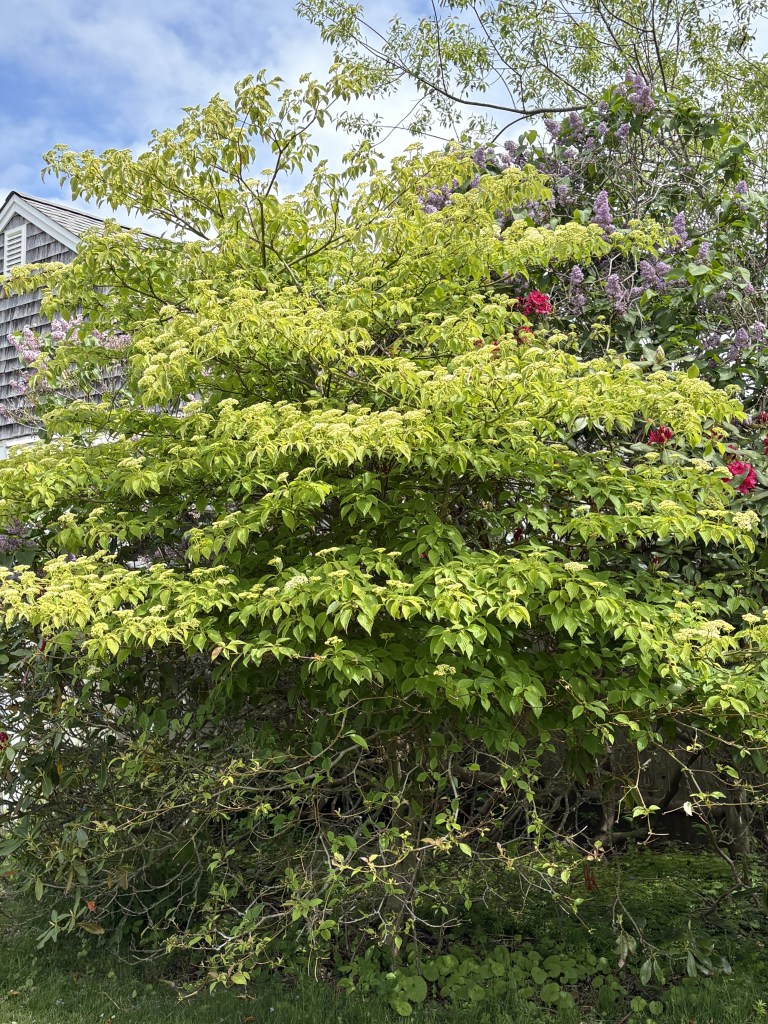
Fragrant sumac (Rhus aromatica ‘Gro-Low’) has small, inconspicuous white flowers in early June. The shrub itself grows only about 2′ tall, but spreads to about 6′ wide. This one is planted outside my shed door, and there are others in the front of a shady border.Pagoda dogwood, or Alternate-leaf dogwood (Cornus alternifolia). This small tree is a volunteer that comes up all over our yard. The flowers are white, similar to viburnum, and it’s as much of a bee magnet as the beach plum was in May. This tree self-seeded at the base of a deep pink non-native rhododendron, and they make such a nice combination I left it there. It has now gotten large enough to see the wide-spreading branches that give it the “pagoda” name. The lower branches are showing where deer browsed over the winter.Wild cherry (Prunus serotina). Another native volunteer, this tree is in its senior years but still puts out a proliferation of these starburst white blossoms each spring. I’m fortunate that there are another dozen of these trees scattered around the property.Great bay rhododendron (Rhododendron maximum). Most of the pink rhody’s seen in the nurseries are imports from Asia, but there is a native rhody that grows in abundance in the Piedmont areas of Virginia and North Carolina. They are sometimes available locally (I got mine, a cultivar called, I think, ‘Independence’, at Crocker’s). They are slow-growing and compact in the sun, but can extend their branches seeking light when in light shade. The blossoms are a lovely light pink and attract the bees, although not as many as the local natives.
Perennials
Somehow I thought I had many perennials blooming in June, but it turns out to only be a few. (Something to plan for next year.)
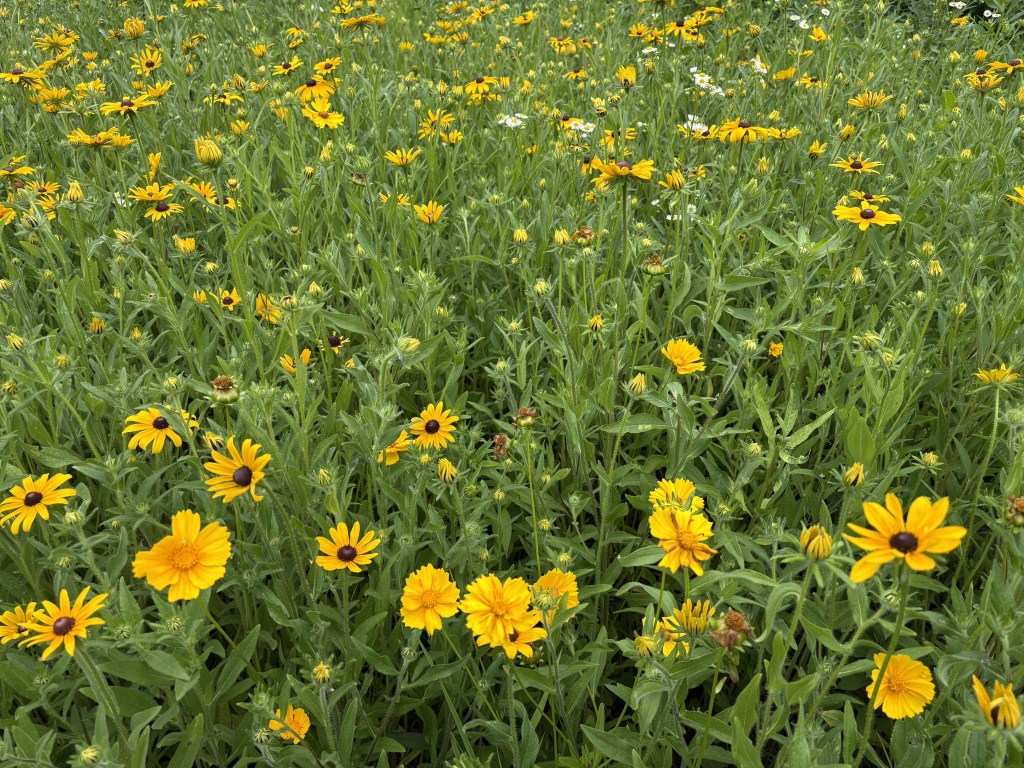
Beardtongue (Penstemon digitalis). Even if I don’t have many species of June-flowering perennials, I have penstemon in abundance, in both the meadow and the Glory Garden. This is the straight species, which has white flowers. In my yard, they seem to be good at seeding around, so they spread delightfully wherever there is open space.Beardtongue (Penstemon digitalis ‘Dark Knights’). I also grow a cultivar, one with reddish leaves and pink-tinged flowers. The colors don’t seem to slow down the pollinators at all, and this plant seeds around even more than the straight species. Threadleaf bluestar (Amsonia hubrechtii). I grow two kinds of amsonia, and both are terrific plants, native further south, that do well here, are avoided by the rabbits, and have light blue blooms in June (The other is Amsonia tabulamontana, with wider leaves.) The threadleaf also has the distinction of lovely yellow leaves in the fall. The only problem with this plant is that it attracts few pollinators. So, I am keeping what I have but not adding more.Coreopsis and Black-eyed Susan. There is a story here. One half of the Glory Garden was planted with daylilies and being taken over by Canada goldenrod. Last year I had all the daylilies removed, with a goal of converting that space (40’x15′) into a meadow-like planting. We put in several dozen gallon-sized native perennials and put down a meadow seed mix to fill in. Well, few if any of the perennials seems to have survived the winter, and now that space is dominated by the seed mix. These two plants are dominant now, but other grasses and longer-lived perennials will follow in later years. Right now, it is a cheerful sea of yellow, with lots of pollinators, yay!




[…] essay: June Blooms for Pollinators (Cathy Weston/Goldenrod Garden) She’s got a native garden on Cape Cod. In this post she […]
LikeLike