As I learn more about pollinators and what their feeding and habitat needs are, I’ve been looking more closely at what is needed season by season. Of course, this leads immediately to an assessment of whether I have enough of the right things in my garden, and whether I need to plant more – or rather, what season should I focus on as I plant more.
One of my concerns is springtime. Birds are arriving back from migration and looking for nesting and food for nestlings. This means lots of insects and caterpillars. To get caterpillars, the answer is easy – oaks, cherries, maples, and other native trees all serve as habitat and provide tasty leaves to eat.
At this time, too, the early butterflies are emerging (I’ve seen the white cabbage and painted lady butterflies so far), the queen bees are back, and flies are buzzing around. These all need blooms for feeding.
So, starting in late April, I’ve been doing a bit of an inventory of what native plants actually blooming. Here’s what I found (and note, I’ve left out daffodils, lilacs, other lovely but non-native plants).
Late April
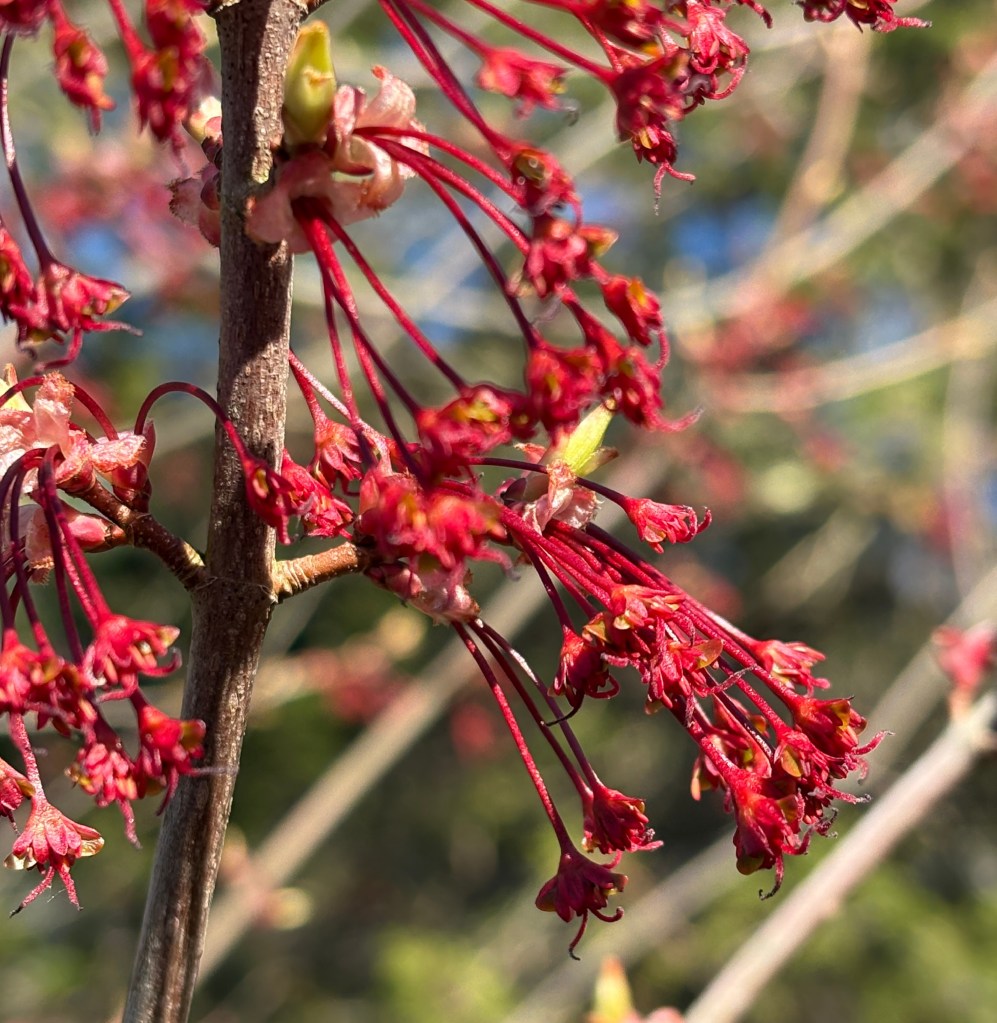
The first thing I found in bloom was not a traditional flower at all, but the red maple tree. Here it is April 24, towards the end of its flowering time. It takes a close-up look to notice that the ends of the red stems are indeed tiny flowers, with anthers and stamens like any other flower. The red maple is insect-pollinated, and I did observe many small bees and flies enjoying these flowers.
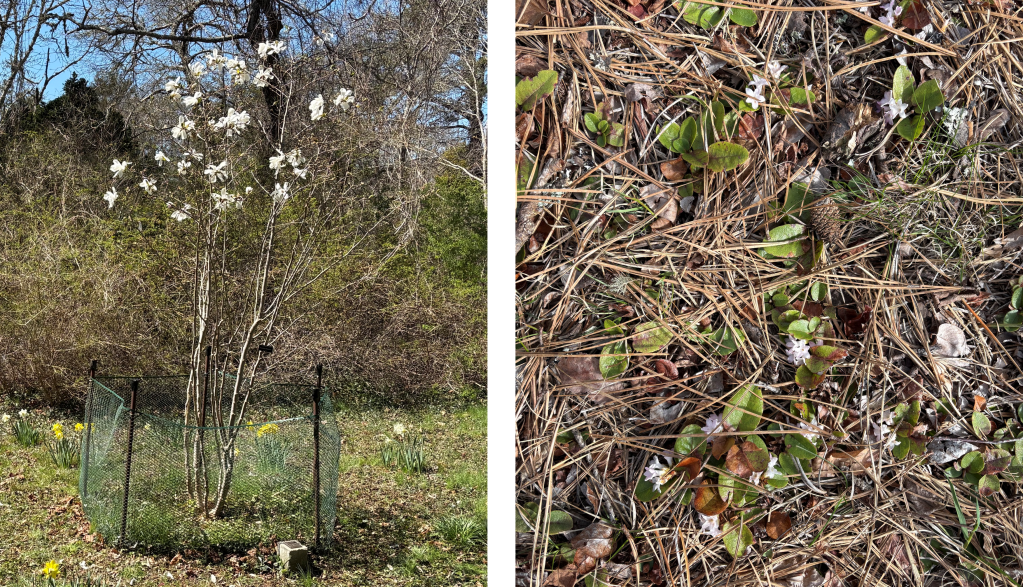
There was not much else in bloom in my yard in April. But a walk in the nearby Sylvan Gardens showed two lovely natives in bloom. The tree is sweet bay magnolia, which I always thought was a more southern plant, but it does occur this far north. It grows usually as a multi-stem large shrub, which has been protected from deer browse with a fence. The ovel-leaf ground cover with small pinkish blooms is trailing arbutus, the Massachusetts state flower. It is a threatened species that, like other heath family plants, prefers the acid soil of pine barrens, I tried growing it once in the acid soil under some Norway spruce trees, but unfortunately it didn’t last.
Early May
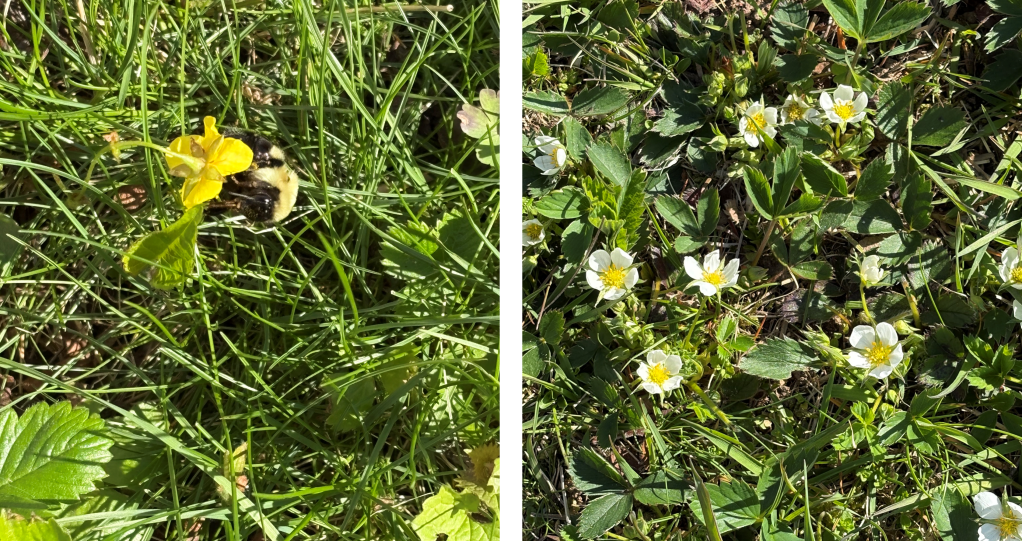
As we come into May, you’ll see that 3 of the 4 flowers I describe are wild – my planted flowers haven’t sttarted their show yet. In fact, the first flowers I see are those in the sunny lawn areas. Despite the chilly weather we have had this year, these two are reliable. On the left is a cinquefoil that I am not sure is native, but it certainly is serving this bee. On the right is of course wild strawberry. While many consider this a weed, I welcome it as it creates patches in my Cape Cod lawn.
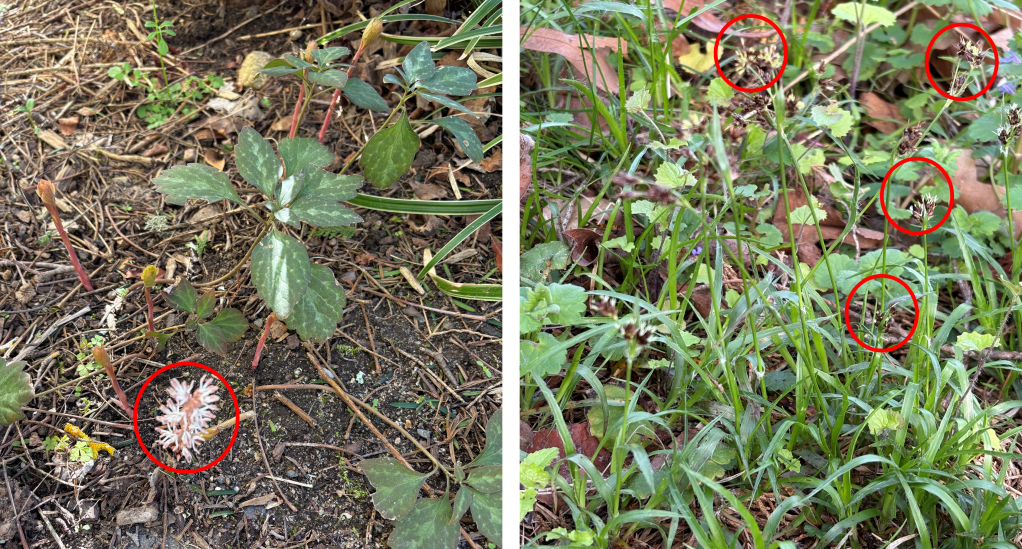
It seems that all sorts of plants bloom in the spring, including ones I generally would not consider a flower. But it’s the insects that feed on these flowers that make that call, so here are two that I have observed insects on but I would not plant for decorative purposes. On the left is the Allegheny spurge, which is our native pachysandra. You can see the leaves are similar, but larger, and it is slower growing than the ornamental pachysandra, but it can still be used as a ground cover. In the red circle is its flower.
On the right is Eastern woodland sedge that grows wild in the shady areas of the garden. It is a great plant, with low arched blades that never get long enough to need mowing, so I let it take over the pathways in the back half of my yard. Its flowers, shown in the red circles, are both tiny and wispy, so look closely.
Late May
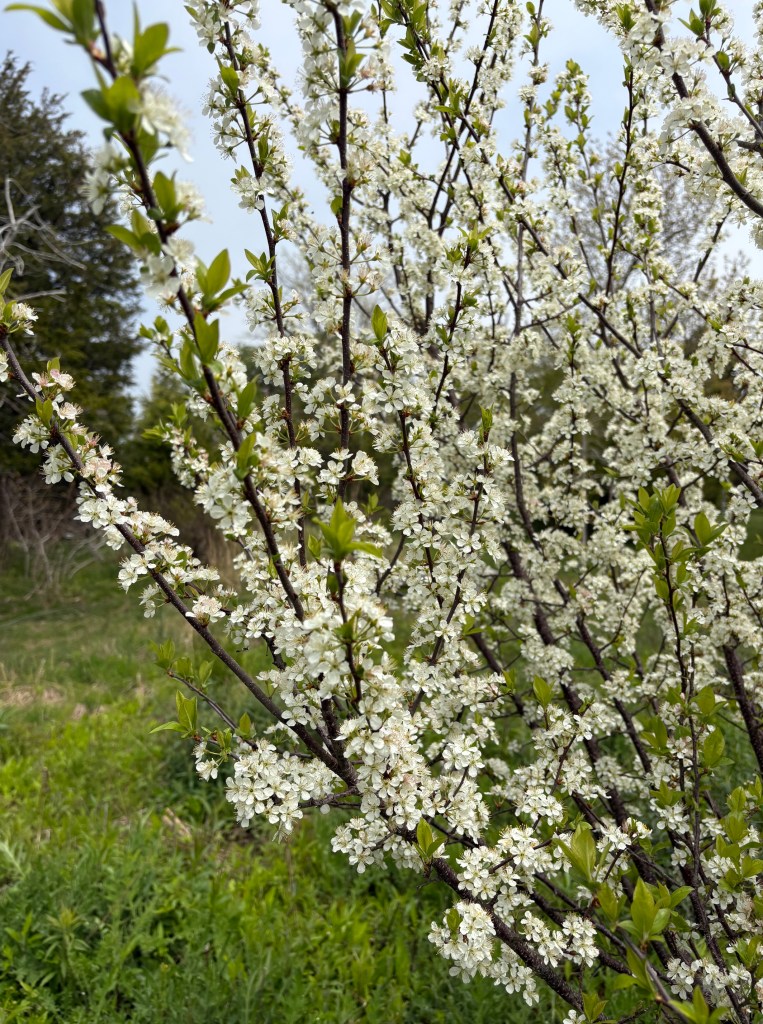
The star of the spring, beach plum, flowers in late May. This is one of the 5 beach plums that grow within the meadow area; there are three more closer to the house, and all of them are covered with bees and other pollinators for a full two weeks. I think I’m doing my part here!
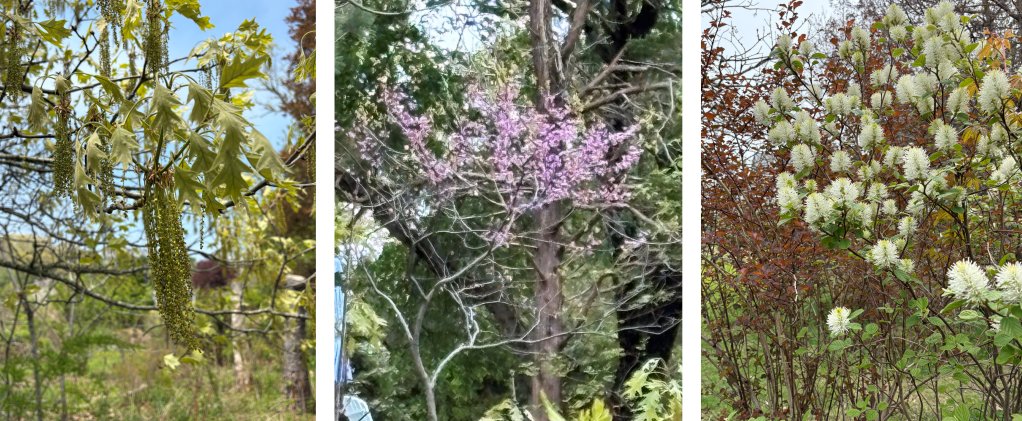
You’ll notice with this next group that many of the blooms in May are from trees and shrubs. It’s a win-win situation, as we humans get to look at lovely blossoms while the pollinators get a food source, all before the ornamental flowers start up.
On the left is a white oak, with its flowers trailing gracefully in the breeze. Oaks are wind-pollinated, so these flowers are not feeding anything. But the emerging leaves will be especially important for a number of insects, both as habitat and as food. Caterpillars (mostly of moths) rely on these leaves, and in turn are part of the food chain that feeds the nestlings of chickadees, bluebirds, and other songbirds.
In the center is blurry photo of a redbud tree in my back property. It’s generally native further south than the Cape, but its beautiful pink-lilac flowers convinced me to take a chance on growing it here. Five years after planting, it has not thrived, but it still survives and puts out a short but colorful bloom. On the right is a fothergilla, another shrub that is from the mid-Atlantic but grows here well. I have it placed beside another mid-Atlantic shrub, a cultivar of the ninebark. I have seen some pollinators at the fothergilla, but it doesn’t seem to be the powerhouse the beach plum is.
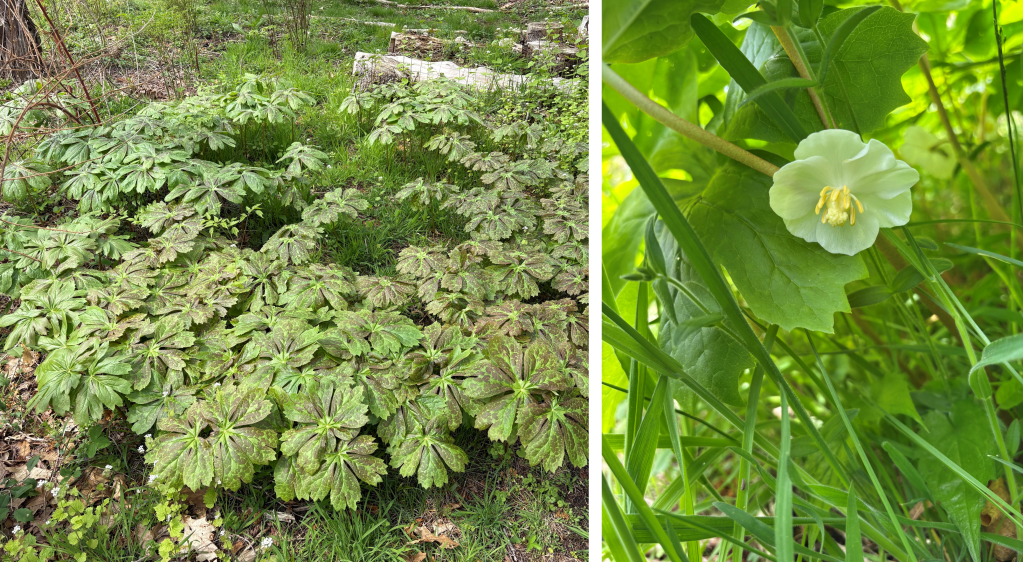
Here is one of my favorite plants of all time, the mayapple. I planted a small clump of these 6 or 8 years ago, and they have expanded into a nice large patch. The leaves always seem to make me think of ancient, dinosaur-era vegetation. Hidden underneath the large leaves are 1 or 2 flowers per plant. I’m not sure how these get pollinated, but in June there will small round fruits (apples) where the flowers are. It is said that the fruits are favorites of the Eastern box turtle. With this many flowers and fruits, I will be out observing for turtles in a few weeks!
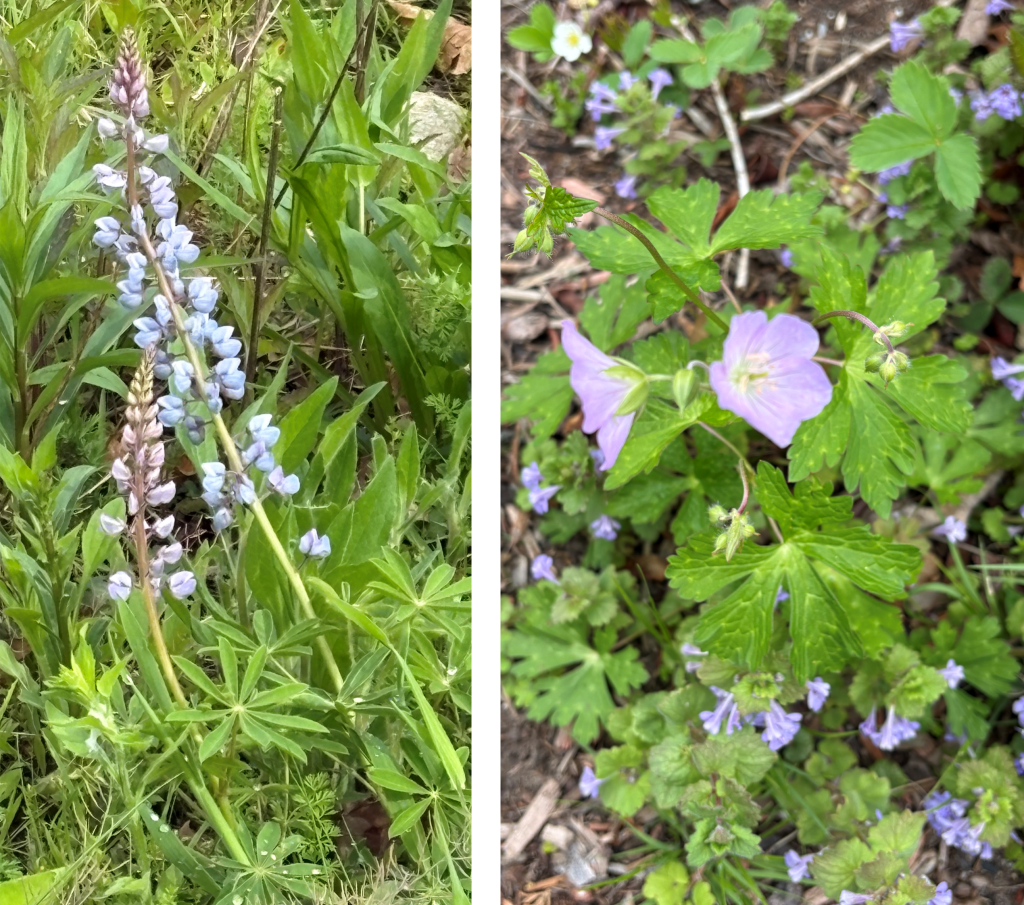
Finally, toward the end of May, the earliest ornamental flowers are appearing. These are still smaller and not too showy, but welcome nonetheless. On the left is the sundial lupine, popping up in the meadow. Last year I added several of these plants to the meadow and crossed my fingers. They are supposed to be quite picky about their conditions, so I am both surprised and pleased that at least one of the plants bloomed this year.
On the right is the wild geranium, with its delicate pink flower (washed out in the photo). I planted a dozen of these a few years ago, but decided to scatter them around the various garden beds where I had a little space. While the plants have all done fine and come back most years, it turns out my planting strategy wasn’t the best for the pollinators. They much prefer having all the plants grouped together, to minimize the time it takes to go find all the scattered plants. So larger groupings of native plants is my go-forward strategy.
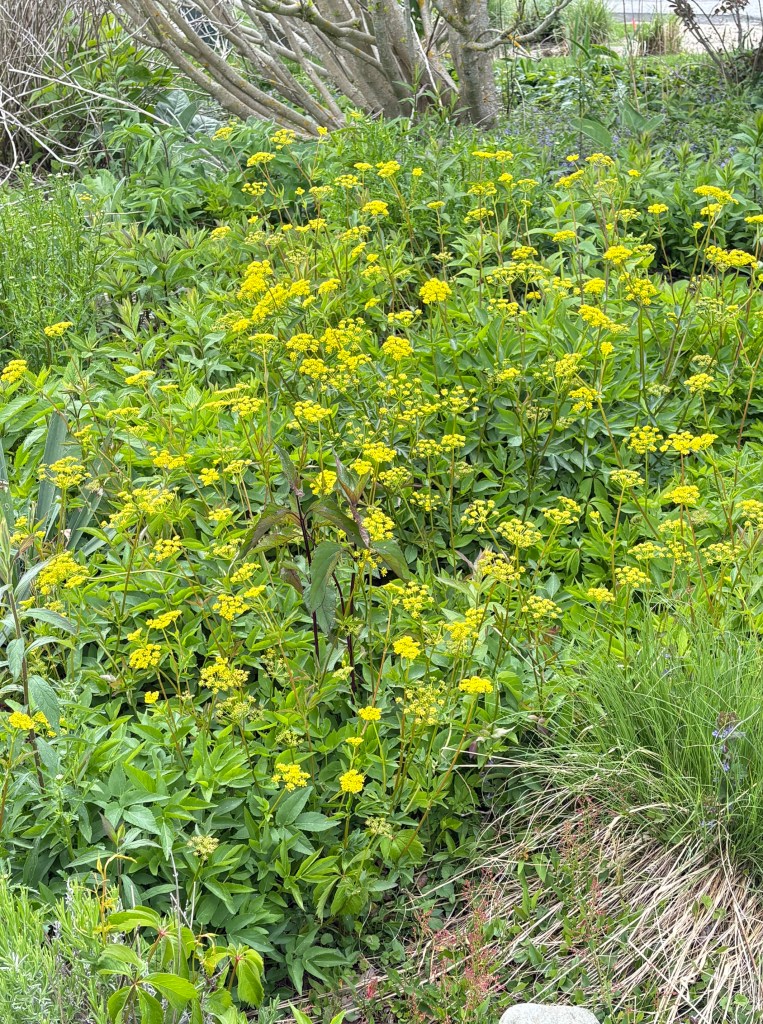
Last, another star of the May garden, golden alexander. This plant is in the carrot family, as you can see from the shape of the yellow flowers. It grows 12-18″”, perfect for the front of a garden bed. Some of the flowers emerged in early May, and more followed all month, to get to a lovely display by the end of May. It also has two traits that make it a great plant – when it likes its conditions, it spread but not too quickly; and rabbits and deer seem to avoid it in my yard. So I have several largish patches of this plant all around the yard.
Final Thoughts
Are there other plants that bloom early, in May? Some quick research show there are two kinds of plants to consider: shrubs and woodland plants (they bloom while they get a bit of sun, before the leaves of the canopy trees emerge). Other shrubs beyond what I’ve shown include shadbush (Amelanchier species), pussy willow (Salix discolor) and blueberries (Vaccinium species). I have some young shadbushes that haven’t bloomed yet, perhaps being nibbled on by deer. I love the idea of the pussy willow, and may need to look for a place for a few (the males are the showiest, but you need a female, too).
The spring woodland flowers, often called ephemerals because they go may dormant and disappear until next year, present some interesting possibilities. Any kind of violet works, and I think I will add some. O there’s to consider: spring beauty (Claytonia Virginians), native Dicentras, Canada mayflower (Maianthemum canadensis), and bloodroot (Sanguinaria canadensis). All of these have white flowers.
one thing I noticed about my early blooming plants – that are scattered around the yard. I’m thinking I should create a couple of places where the early blooms are concentrated. There are a couple of shade/part shade areas that are good candidates. I can start by adding some. Inlets this year, and make space for some more ephemerals next year.
As I type this, the June flowers are already starting to show their display. Stay tuned for the next report!


[…] mentioned in the May post, this year I am tracking all the native plants and the months they bloom in. The goal is to […]
LikeLike