We are in a transition period, with the late spring blooms gone and the late summer blooms just starting. But there are still plenty of interesting things to look at. Come take a walk with me around the garden and look at the successes – next time I’ll show you what is not working LOL.
Glory Garden and Lower Slope
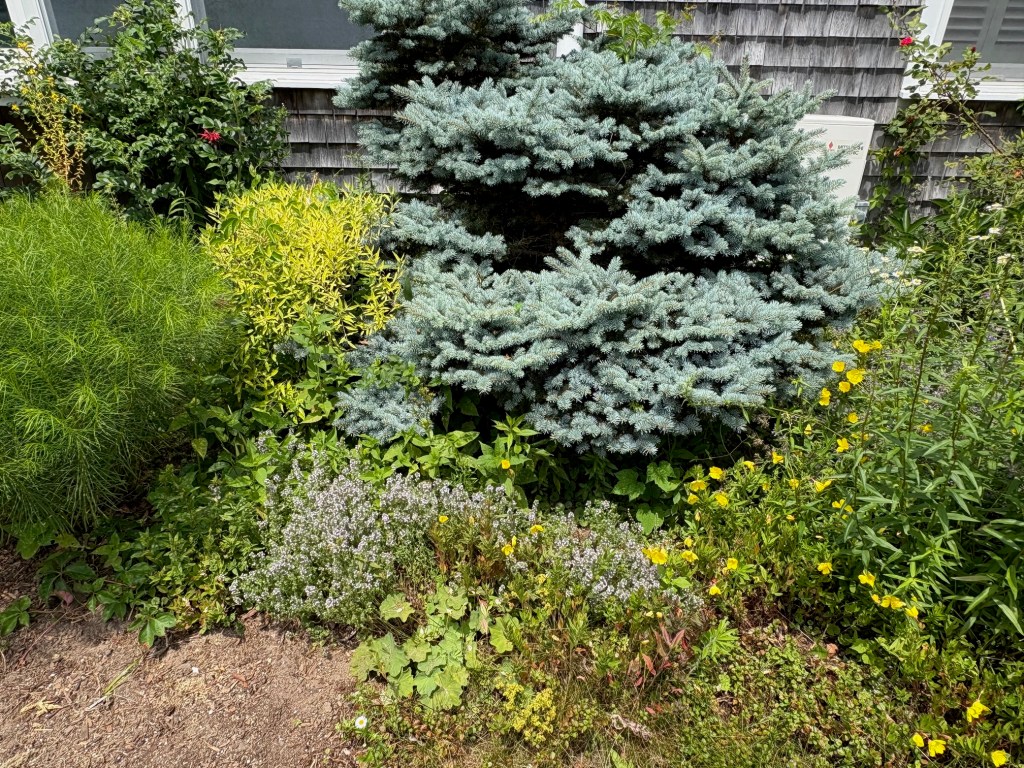
I am still enamored of my blue and yellow combinations, especially with lots of interesting textures. This is a mix that I started well before my native plant journey, but the addition of some native plants makes it even better. The shrub in the center is a dwarf blue Norway spruce, and next to it is a golden caryopteris, non-native but still loved by pollinators.to the left is an amsonia, its blue blossoms already done, and below them in light blue is golden thyme. The yellow flowers in the lower right are a cultivar of the native sundrops (Oenothera). The bare ground is where I just dug up some daffodils. I’m looking for a new front-row plant to put there.The garden bed that anchors the statue is coming along nicely. The prairie dropseed around the base is almost at its full size and is making a lovely contrast to the steel and concrete base. Behind that is an area of golden alexander (Zizia aurea) that has finished, and the potentilla shrubs in the far back are just starting up.
Woods
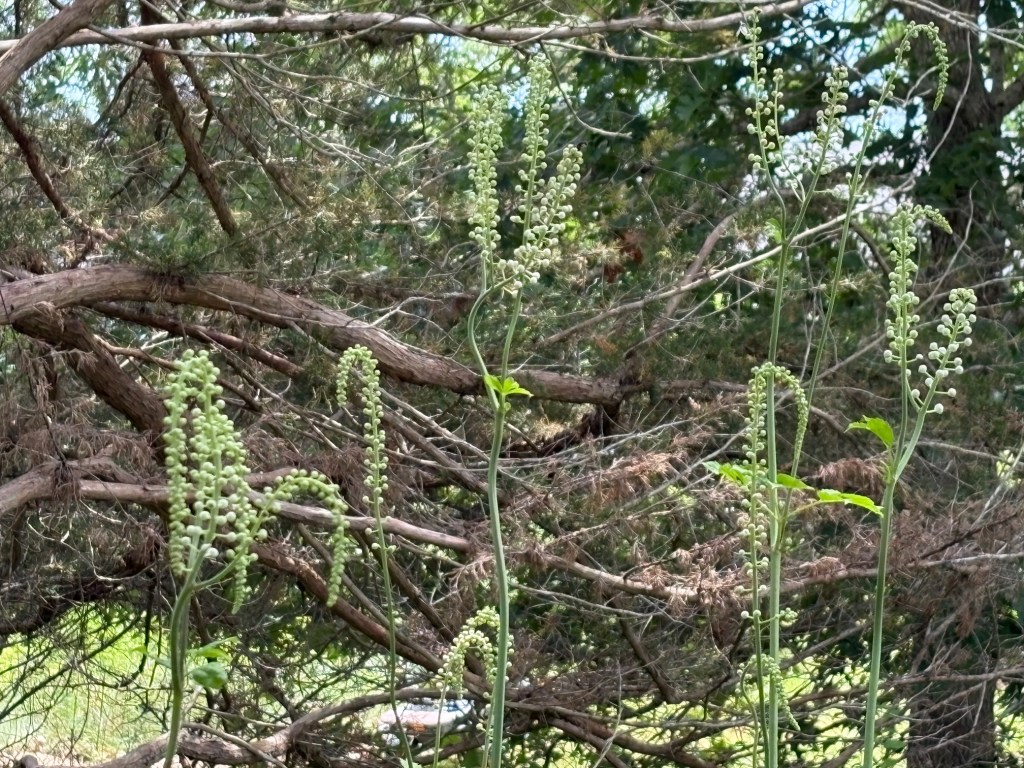
There is a section of the woods that I have not touched at all. It has a wild cherry, some cedars, a pitch pine, and an old arborvitae as trees. The ground layer is mostly wild blackberries, which I will have removed and replanted with a better shrub layer later. But three years ago, this volunteer started up. It is a purple flowering raspberry (Rubus odoratus), a native plant that is as large as a shrub but dies back to the ground each year. It flowers later than other raspberries and blackberries, has no thorns, and produces edible fruit that I let the birds eat. It is kind of thrilling to have a valuable native plant just show up and thrive!The black cohosh (Actaea racemosa) is just getting ready to flower. I have said this is one of my favorite perennials, and it seems it is a favorite of all the native bees in the neighborhood, too. The flowers will last through the end of July.
Meadow
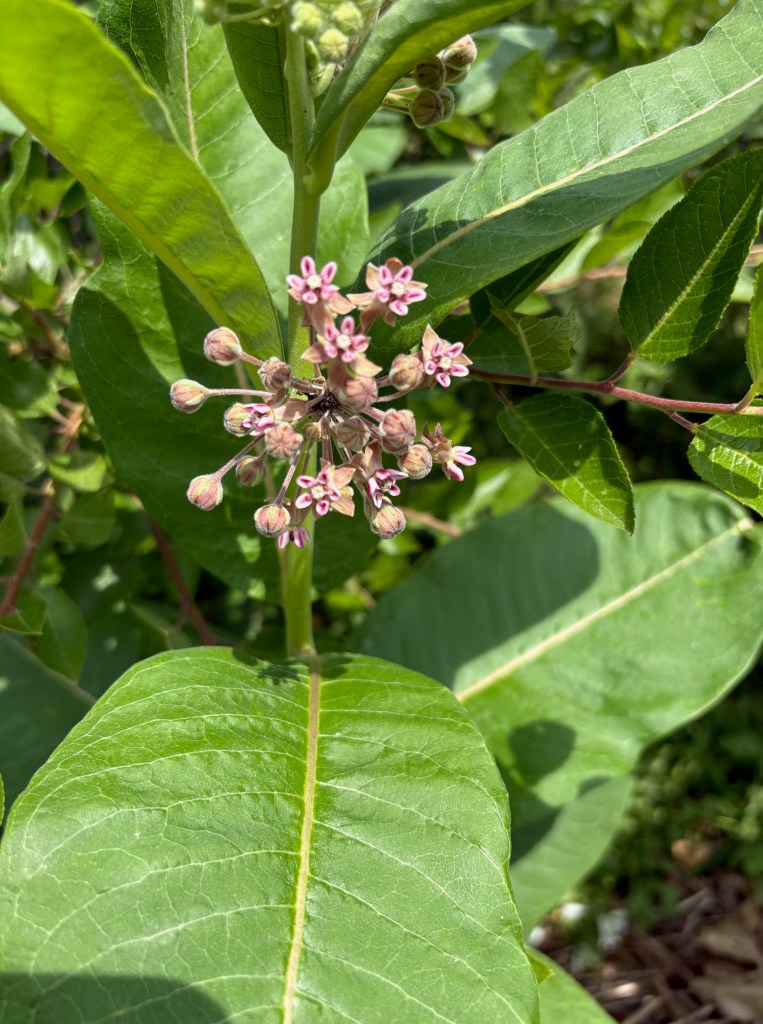
Another native plant just getting ready to bloom. This is the common milkweed (Asclepias syriaca) and the flower will very shortly be a pretty pink sphere of smaller blossoms. This is also a volunteer that I am allowing to reseed in the meadow. I haven’t seen any monarch butterflies yet, but will keep looking.I know this isn’t the most glorious picture, but I wanted to show that finally the grass layer in the meadow is taking hold. Most of those grasses are little bluestem (Schizachyrium scoparium) and the end goal for this section of the meadow is to have lots of perennials rising up above a pretty dense but lower grass layer. The single stems seen here are a combination of blue vervain (Verbena hastata) which is starting to bloom now, and bee balm (Monarda fistulosa) which will bloom later.And last but not least, beautiful plant combinations in the meadow are starting to be seen. The orange is butterfly milkweed (Asclepias tuberosa), the purple is blue vervain (Verbena hastata) and the while is slender mountain mint (Pycnanthemum tenuifolia). Because several of these plants are short-lived but seed around, the combinations differ every year, and it’s fun to capture these ever-changing scenes.




 Goldenrod Garden
[…] essay: The Early July [Cape Cod] Garden (Cathy Weston/Goldenrod Garden) Meadow with milkweeds and little bluestem, woods with flowering […]
LikeLike
Your newsletters never cease to amaze!! Gorgeous gardens!!Sent from my iPhone
LikeLike