This is the start of a new series of posts, each one focusing on a different genus of native plants. In each post will be profiles of the more common species, including what different reference sites say about the plant, as well as how it has done in my garden. One of the biggest challenges in moving toward native plants is getting to know the myriads of plants, so I’m hoping this series will encourage people to try new plants in their own gardens. I will be starting with plants that have done well for me and will generally include plants that are native to the Northeast and available in the native plant nurseries here in Massachusetts.
We are starting with my favorite shade perennial, the Actaea (formerly Cimicifuga) family, also known by the less-glamorous names of baneberry, bugbane, and cohosh. There are dozens of Actaea species around the world but the species I have grown, black cohosh, red baneberry, and white baneberry, are the three native to New England. Some characteristics they all have in common:
–They require part shade to part sun and grow best in acidic, average to moist soils. All are very hardy, growing in zones 3-8. They form clumps and spread slowly over time.
–The leaves are divided, almost fern-like but a bit larger, so they go well with ferns and sedges in a shady situation. They stay attractive throughout the summer.

–They flower in late June and July, later than most shade plants, which is useful to making the shade garden more interesting at a time when shade gardens are mostly all green. The red and white baneberry produce berries in late July and August, adding to the interest.
–The berries of these plants are toxic to small mammals, including children and rabbits, as they contain cardiac toxins that have a sedative effect on cardiac muscles. The toxins don’t affect birds, the plant’s primary seed disperser. Note, I do not have children who frequent my garden, so I am not concerned on that score; and the toxicity means that those pesky rabbits will not nibble on these plants.
–A fun fact: the old name Cimicifuga means “bed bug repellant”, implying that this plant was useful in herbal medicine.
Black cohosh (Actaea racemosa)
This is the most substantial and dramatic of the three species. In its preferred conditions the base of the plant will be a 2-3′ tall with large, divided leaves, interesting in their own right. In late June or early July, tall spiky flower stalks will emerge, rising to 4-5′ tall. It is native to open woodlands in most of the eastern US and Canada, If you are looking for an architectural plant in a shady area, this is the plant for you.
Pollinators, especially the native bees, cover the flowers for weeks as the flowers mature from bottom to top. The plant forms seeds, not berries.

I grow this plant in two locations, both of which were planted 6 years ago. There is a large group of 7 plants in the woodland garden, and they have done well there, creating a lovely show in July. This area has acidic soil, but it is not particularly moist, so while they are growing fine and bloom regularly, they are probably not at their best. If I ever have any compost to spare, I may try to give them some better soil. The other location is right next to our outdoor shower, and the extra moisture they get makes a difference, as this one plant has larger leaves and more flower spikes and has spread to two additional plants.
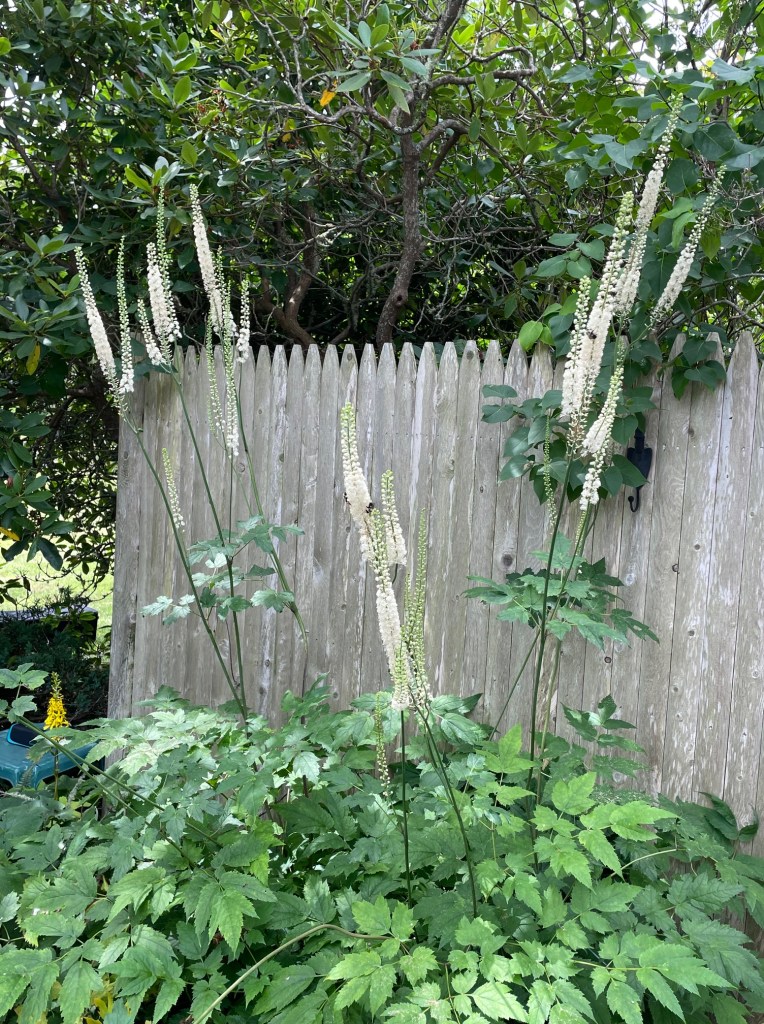
A couple of notes on this plant: while it is native to New England, it appears in the wild primarily in the Berkshires and western Connecticut. Also, I have seen a few cultivars of the plant in nurseries occasionally; I tried a purple-leafed cultivar two years age, and while it is surviving, it is not thriving and hasn’t yet flowered, so I can’t speak to its pollinator value.
Red baneberry (Actaea rubra)
The red baneberry is the most common of the Actaea, being native all-over New England and seen in the wild in woodlands with rich, moist soil. The base plant has the same large, divided leaves and grows to 18″ or so height and width. The flowers are the same white as the black cohosh, but are a more rounded shape, like a snowball. This plant is native throughout the northern US, and Canada.
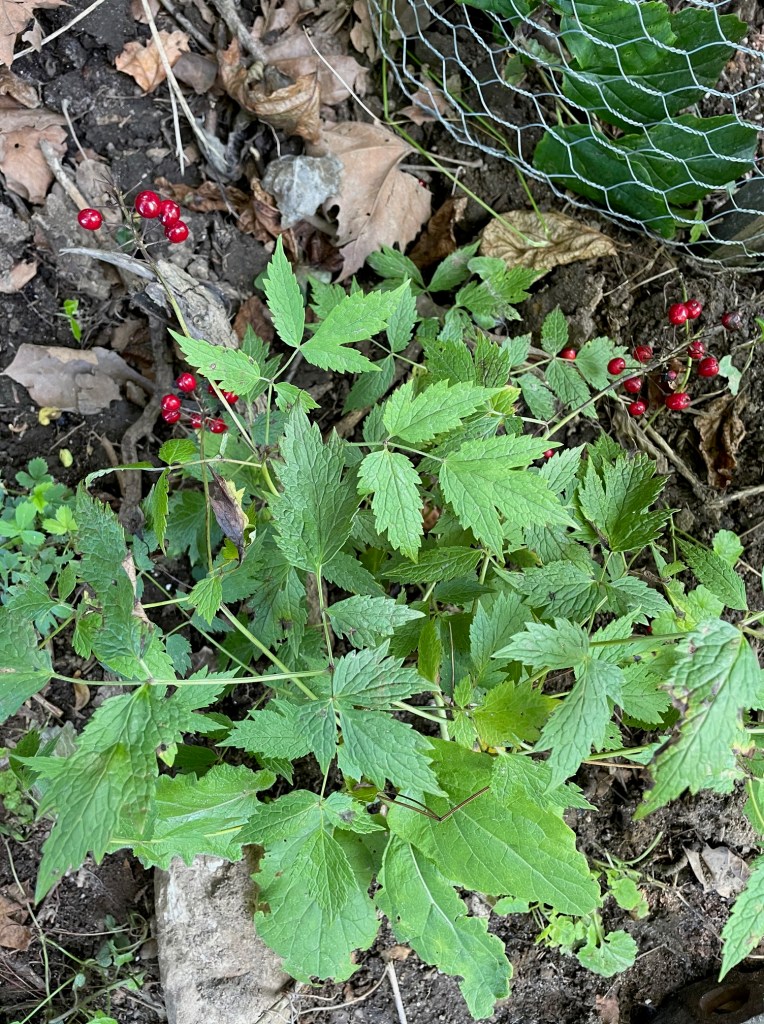
The flowers attract pollinators, and the red berries, which are the earliest berries to emerge in the summer, are a good source of food for birds and the small mammals that can tolerate the toxins.
I have a long drift of these plants that winds its way through the middle of the woodland garden. They have been in place for 7 years and are doing fine. In the early years, they stood out with their larger leaves and white flowers; I seldom saw the berries because the critters got there first. But as the garden matured and it got shadier, they seemed to blend in with the shrubs and become less noticeable. I think that massing these plants, or positioning them more as a specimen, would have been a better planting design choice than a drift.
White baneberry (Actaea pachypoda)
I have just managed to find and plant some of this species this year; they are popular, so you have to act fact when you see them for sale. The reason for this popularity is their unique berries, called dolls eyes.

The base plant is much like the red baneberry, perhaps a bit smaller. The flower is also white, but it is an elongated panicle, halfway between the spikes of the black cohosh and the snowball of the red baneberry. The flowers turn into pure white berries, each with a black “eye” on the fruit tip, making it look like an eyeball staring out from a doll. This plant is native throughout the eastern US, including the South.
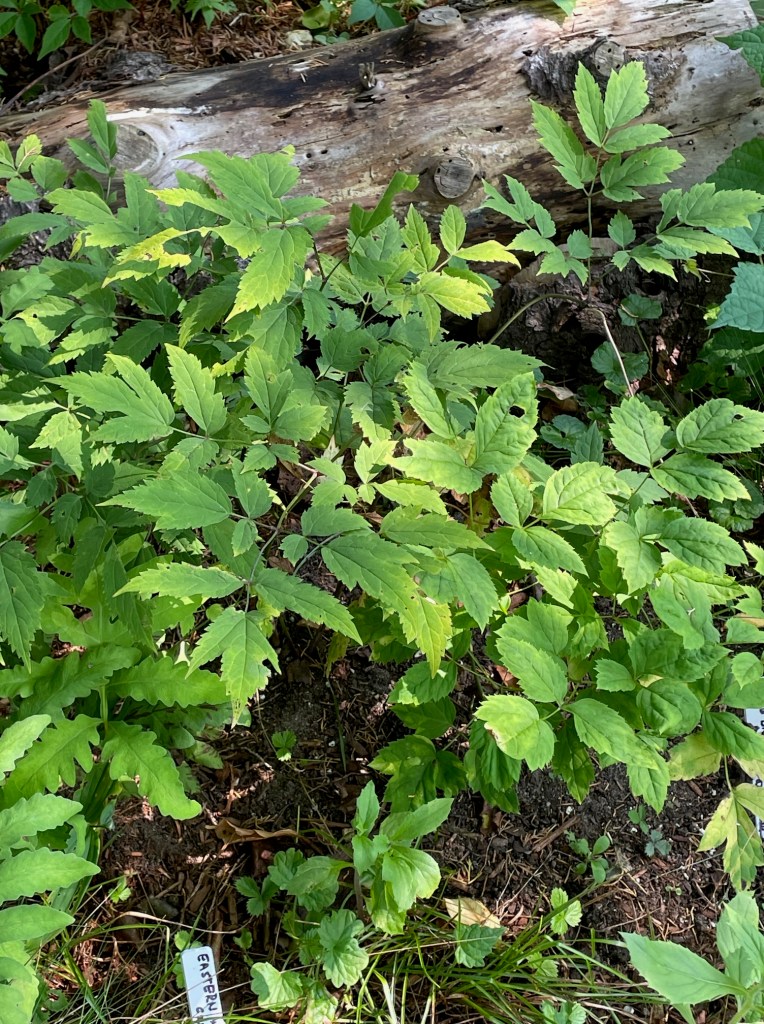
In my garden I am trying them in two places. One is in the woodland garden in a new spot I started last year for ferns and sedges. The other is at the end of the Glory Garden, in a shady spot under a Japanese maple. The plants in both sites have done well this summer but have not flowered. I will be watching for blooms next year.
Sources: Information for this post came from Native Plant Trust’s Garden Plant Finder, Native Plant Primer by Uli Lorrimer, and Wikipedia.
 Goldenrod Garden
Is it pronounced Act-ee-a?
LikeLike
Thanks, this is great info!
LikeLike
[…] Plant Profile – Actaea (Cathy Weston/Goldenrod Garden). “We are starting with my favorite shade perennial, the Actaea […]
LikeLike