Doesn’t it seem odd that a blog/newsletter called Goldenrod Garden has never had an article dedicated to goldenrods? It’s time to change that! In this post I will discuss identifying wild goldenrods, and then review several different, better-behaved species available in nurseries.
While goldenrods have a bad reputation among traditional gardeners, they bring many benefits to the ecological gardener and are worth considering. Goldenrod is one of the keystone plants for Cape Cod, meaning that plant for plant, they supply a powerhouse of nutrients and other ecological services for pollinators and other insects. According to the Penn State Extension Service:
A prolific nectar and pollen producer, goldenrod supports bees, wasps, butterflies, moths, and beetles. Eleven species of native bees are specialists in goldenrod and seek this specifically for their diet. It is also the host plant for several butterfly and moth larvae, including the wavy-lined emerald moth (Synchlora aerata). Goldenrod produces high-quality pollen, rich in protein, fats, and minerals, and is critical for migratory insects like the monarch butterfly.
Goldenrod is also host to around 50 species of insects, including flies, moths, and midges, which lay eggs or overwinter in the stems. One common insect is the goldenrod gall fly (Eurosta solidagnis), a tephritid fly smaller than the housefly with translucent wings mottled with brown splotches. This clumsy flier only lives 10 to 14 days and completes its entire life cycle on goldenrod. Each species of fly is specific to a specific species of goldenrod.
Goldenrod is often blamed for seasonal allergies. However, its pollen grains are large, sticky, and dense. They are too heavy to be carried by wind and are carried by insects. This is quite different from ragweed, which blooms at the same time. Ragweed is wind pollinated, and one plant may produce a billion grains of pollen. This lightweight pollen may remain airborne for several days and can wreak havoc with seasonal allergy sufferers.
All goldenrods prefer full sun and are tough plants that can work in most soils, including very sandy or clay soils. Once established, they should require little to no supplemental water. They flower late in the season, and the flowers consist of clusters of miniature daisy-like blooms.
Wild Goldenrods
If you leave a spot of open soil in sunny conditions anywhere on Cape Cod, it won’t be long before goldenrods appear. That was my first experience with them, and I loved their display of bright colors at the end of the season, attracting pollinators when there is little else blooming. So, I let them stay.
Once there were several clumps of goldenrod around the yard, I pulled out my book on Wildflowers (the Peterson Field Guide), turned to the section that describe 29 different species of goldenrod, and tried to identify which ones were growing in my yard. It was kind of hopeless, as the differences between species, to my eye, were too subtle.
This year, armed with both the Wildflower book and an app for plant identification (Plant Net), I tried again, with somewhat more success.
The first foray was in mid-August, when the plants were tall but flowers had not appeared, and then again in early September once there were flower clusters. I used the app to determine one particular clump was rough-stemmed goldenrod (Solidago rugosa), then studied the book to learn its details. In this species, the leaf itself is relatively short and noticeably rough, as is the stem, and the flowers branch out at the top much more widely than other goldenrods. Those two features seemed enough to be certain of the identification, and I felt glad I could at least identify one of them!

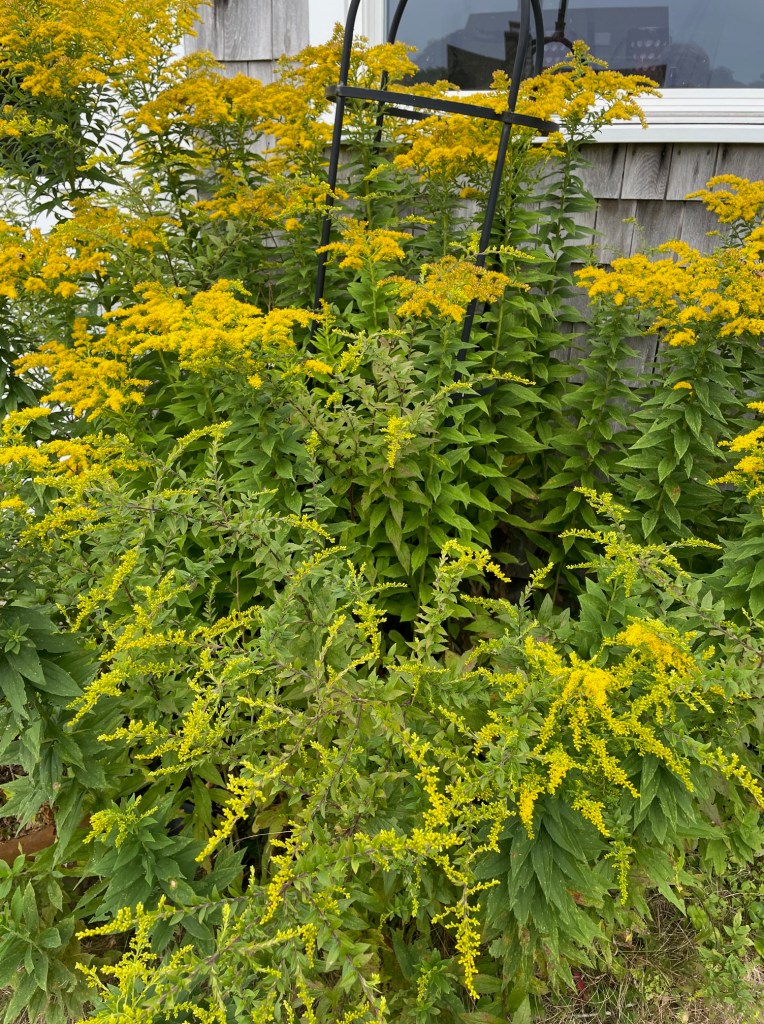
A second clump was trickier, as the app showed it had a 33% probability of being tall goldenrod (Solidago altissima) in August when and a 27% probability of being Canada goldenrod (Solidago canadensis) in September once it bloomed. It turns out that the difference between the two is very subtle – the degree of serration on the edge of the leaf and whether or not the stem is smooth or covered with downy hairs; tall goldenrod is less serrated and has a downy stem, and Canada goldenrod has sharp serrations and a smooth stem. The height isn’t a clue – my plant was 4’ tall while tall goldenrod is 3-6’ and Cananda goldenrod is 1-5’. Since everything I read about local goldenrods emphasizes that Canada goldenrod is more prevalent here, I decided I would treat my clumps as if they were Canada goldenrod.


In my garden, Canada goldenrod spreads aggressively, both by seed and by runners, and it is one of those plants I am always pulling up as weeds in unwanted places. Rough goldenrod does spread, but less rapidly – I would say 80% of my wild goldenrod is Canada goldenrod, and 20% is rough goldenrod. They make nice tall clumps in the front yard and next to the shed door, and they have filled in empty spaces behind the Glory Garden, in the woodland, and in the far back. I am going to keep these plants but confine them to designated areas and weed them out elsewhere.
Goldenrods for the Garden
Fortunately, there are a number of other goldenrods that are equally valuable but not as aggressive as the wild goldenrods. Here are the ones I have tried; note that all but one are native straight species, and all are available in native-plant nurseries.
Seaside Goldenrod (Solidago sempervirens)
Quite differently shaped from the Canada goldenrod, the seaside goldenrod grows wild on sand dunes – I’ve seen it on the Morris Island trail, where it tends to sprawl. Its leaves are wide and tapered, and almost seem fleshy, so the plant has substance even before it blooms. It can grow 2-8’ and works well in average garden soil as long as it gets full sun. We planted it in the mini-meadow at the Mayo House and it has grown well with little supplemental water; it seems to be slowly spreading out at the base rather than spreading through seed dispersal.

Sweet Goldenrod (Solidago odora)
This is a smaller plant, only 1.5-3’, but otherwise looks like the Canada goldenrod. Its fun feature is that the crushed leaves smell sweet, a bit like anise. I planted it in my Glory Garden three years ago; it has come back every year and is very slowly spreading. I have it rising above a short sundrops cultivar, so there is yellow in that spot most of the summer. Note that this plant blooms earlier than other goldenrods; in my yard it was in full bloom at the end of July.
Showy Goldenrod (Solidago speciosa)
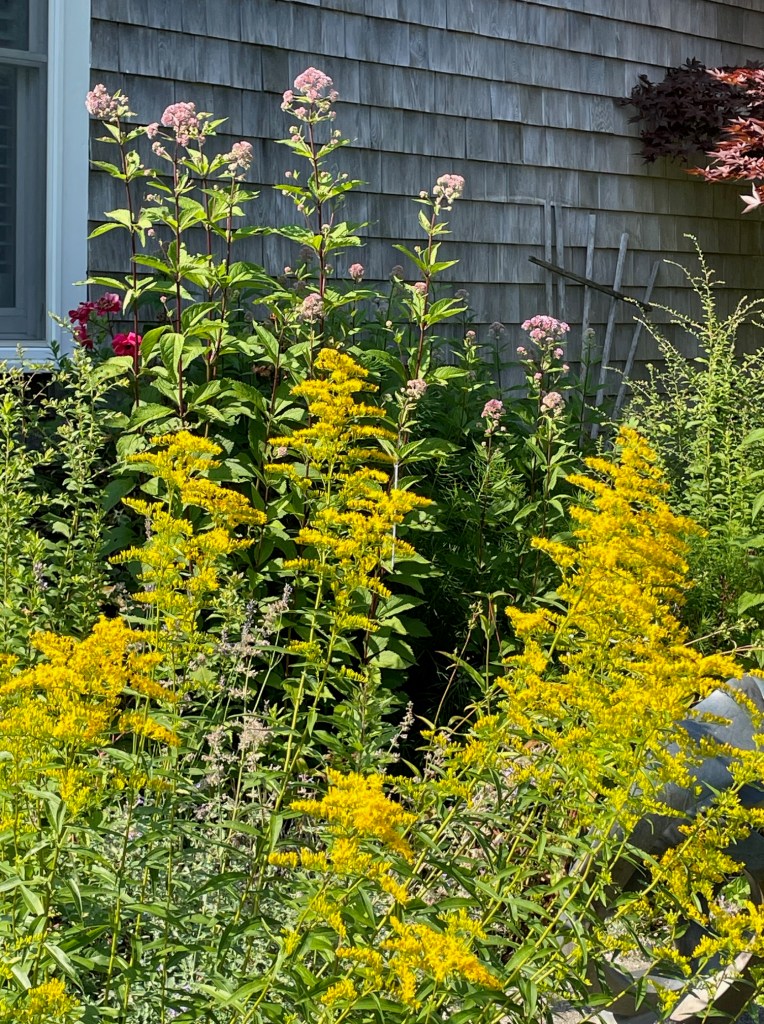
I have tried growing this plant for several years, but every time I planted it the rabbits ate it, the only goldenrod they have bothered with. This year I planted it in the meadow, behind the rabbit fence, and it was just as showy as promised. The flowers don’t form plumes like the Canada goldenrod but form large clumps at the very top of the stem. The individual daisies are more prominent and help make this a visual delight. It can grow 2-6’ (mine were 5’), has larger leaves, and can tolerate richer soils.
Fireworks (Solidago ‘Fireworks’)
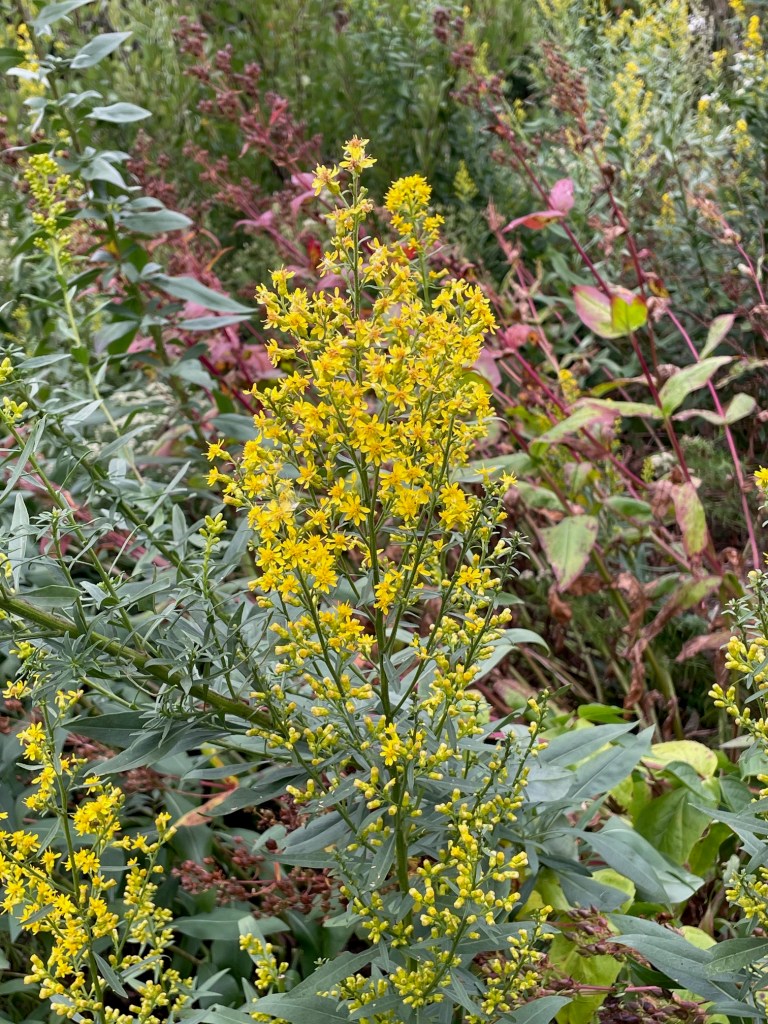
This last species is a cultivar of the rough-stemmed goldenrod. It was bred so that the flower stems arch more gracefully than its parent, and when it is in bloom it does indeed look like fireworks. In my Glory Garden it has done well for the last 3 years and is slowly spreading; in another 3 I may have to divide it to keep it in its allotted space. This plant seems to bloom a little later than the others.

Other goldenrods seen in the native plant catalogs include:
Gray goldenrod (Solidago nemoralis), which grows in dry and sandy soils such as old pastures. It is small, 1-2’, and not very showy. The gray in its name comes from the grayish stem, which is covered in fine hairs. Locally, it grows wild in the meadow on Strong Island.
Zig-zag goldenrod (Solidao flexicaulis), which has an angled stem as the name implies. At each change in stem direction there is a broad leaf and a small cluster of flowers. It grows 1-3’.
Blue-stemmed goldenrod (Solidago caesia), which is a 1-3’ tall, slender plant, with dense clusters of flowers at the base of each leaf.
 Goldenrod Garden
[…] with photos: Plant Profile – Goldenrod (Cathy Weston, Goldenrod Garden, Cape Cod). Weston looks at wild goldenrods — Canada goldenrod […]
LikeLike