The quiet time for gardening, the winter season, seems to go by quickly with hours spent learning, attending webinars, sitting at my desk and computer planning for next season. Along about mid-January I remember that I should also be exercising, both for general health and to prepare myself for an active gardening season.
This year I adopted the rowing machine, and one day I turned on one of my favorite gardening podcasts, “Growing Greener” with Tom Christopher. Tom is an accomplished horticulturalist and author in his own right, but for his podcast he brings on experts to discuss different aspects of ecological gardening. For example, he did one entire hour dedicated to the different native grasses you might garden with instead of the imported Asian grasses. (Spoiler: little bluestem!)
One day he interviewed Madeleine Hooper and Jeff Hughes, who are the co-hosts of a PBS TV series called “Garden Fit.” The premise of the show starts with Madeleine, a gardener who was having too many aches and pains, and her work with Jeff, a personal trainer, to get her to be fit for her gardening. In each show, Madeleine and Jeff visit a private garden or farm and tour while talking with the gardener about their intent, style, and challenges with the garden itself, and then Jeff gives the gardener tips and techniques for alleviating and preventing their particular aches and pains.

Aha, I thought, I need that! Most of my gardening sessions leave me with at minimum an aching back, and if I could do something about it that would be great. So, I went to my local PBS station and signed up for a Passport membership (free with donations above a certain amount), downloaded the PBS app onto my tablet, found the show and started watching.
It was a fun series to watch. The gardens are all different styles, from a lush Japanese-inspired garden to a Miami tropical garden to a Midwest Native American farm to a California desert garden. In each episode the gardener has different physical challenges that Jeff helps them with, such as exercises to stretch the hands after grasping hand tools and weeders all day.
You will have to watch the series to see all of the gardens and get all of Jeff’s pointers, but I’m going to share a few key ideas. You may be aware of some or all of these (I was) but I have found that incorporating these consistently into my gardening has helped a lot.
How to Bend Over
It turns out there are two places in the body that can serve as hinges to bend over – the waist and the hips. If you bend at the waist, you curve your upper back downward and then have to work the erector muscles (the muscles on either side of the spine) to stand up again. But if you keep your weight in your heels, stick your fanny backwards, and hinge at the hips while keeping your back straight, it is much easier to stand up again. Your glutes, the strongest muscles in your body, are doing the work.
If you have to bend down to pick up something heavy, put one foot on either side of the object, close to it but hip-distance apart. Then squat down, pick up the object, and hold it against your belly and hips. Then just stand straight up from the squat. No using your back to help lift, just the quads and glutes.
How to Get Up and Down
If you are like me, a morning’s gardening includes getting down on the ground to do a task, then getting up and moving to another spot, a hundred times. All of this up and down was the primary cause of the achiness. The solution is similar to the bending recommendations, in that it uses quads and glutes rather than back muscles.
To get down, stand with legs apart, feet parallel, and squat down so you can rest both arms on your thighs. Jeff calls this the “armchair position” and it is the base for moving around close to the ground. From the armchair you can lean over directly, put one knee down, or put both knees down. You can swivel right or left, as well.
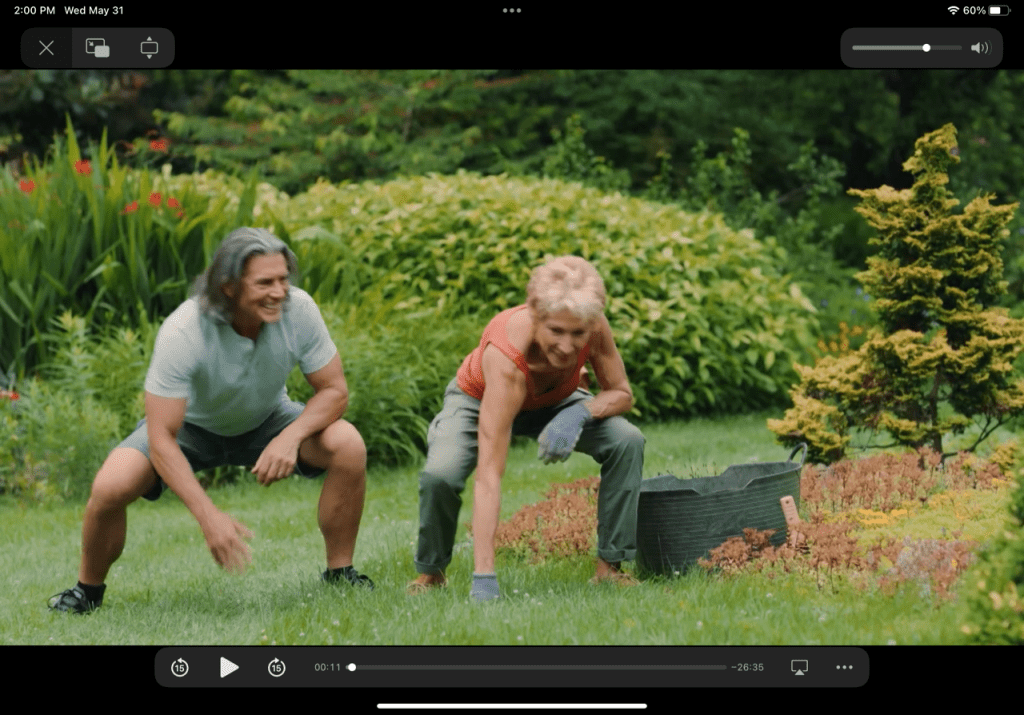
Getting up just goes in reverse. Suppose you are kneeling on two knees. Put one foot flat on the ground, and rest your arm on the thigh, as in the armchair position. But instead of trying to stand up on just that one foot, swivel that foot toward the other foot, and put the second foot also flat on the ground, so that both feet are parallel. You are still squatting here, back in armchair position, and now you can just stand up.
Balance and Variation
Repetitive motion is a big cause of gardening aches and pains. The solution is to vary your work, so you are not doing any one motion for too long and you are balancing out the work across all sides of your body. If you are working low, stand up every 10 minutes and take the weeds to the compost and get a bit of stretch. If you are trimming hedges or raking with your dominant hand, practice with the other hand as well so you can work the other side of the body. If you are weeding a big patch, kneel in the center, then twist from the waist to weed both right and left sides. That twist gives the back muscles a bit of a stretch, too.
I have been trying to consciously use these techniques and turn them into habits. The motions feel a bit strange at first, but they are becoming more familiar. One day soon muscle memory will start to make the motions routine, so I don’t have to think about them anymore. I do find that after a gardening session my back recovers faster, and with less ibuprofen, when I have used these motions. Of course, the big test is coming up, when I have to start weeding the newly-planted meadow!
 Goldenrod Garden